

Part 2
(Part 1 can be found here, Part 3 forthcoming)
In this moment, be with us. In our efforts to share our lives, imbue us with divine strength, divine courage, and divine faith. That as we are lighted, may we be a light unto the world, to that which is life, to that which is light, to that which is love made manifest, to the indwelling spirit that unites us on this earth for a higher shared purpose, may we open ourselves to the inflow of divine wisdom, divine love, and divine faith, that we might surrender our will to the highest good that it may fulfill itself through us into our time and into our world. We are here. Thank you for being with us
My heart woke up this morning with tremendous gratitude in a very personal way to my mother, and I would like to dedicate today to her. Her name is Isil Beatrice Bishop, and it’s her 90th birthday. I had a quick call with her. She lives in Newark, New Jersey. But in my awareness of how much she holds the entire family all across the world, she is the one that knows all their numbers and what time of day to call them for anything.
But it’s just a certain awareness in me, uh, growing up that quickly she can attune herself to every child in our family, which is, there’s seven of us, plus all the other relatives, and the awareness that she could attune to the particularities of soul. And she will still call me and ask if I ate. You know, the motherly thing to know what is needed and how to support it. And so I am very grateful, and I would like to just light this candle in her tribute to say thank you for the life, light, and love that’s been embodied through the ancestors, to her, to me, and to what I give and do in the world. May her day be filled with gratitude and love.
Thank you for sharing this moment with me as well
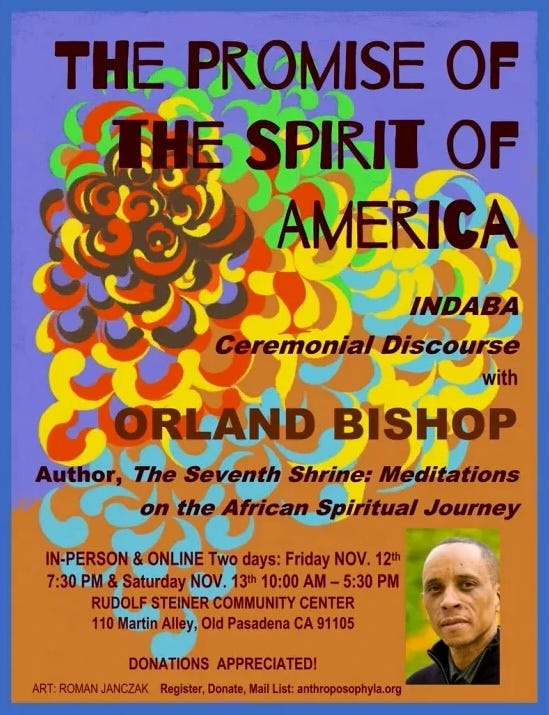
Welcome. An Indaba is a process of shared time, shared space, shared inquiry into life. It’s a tradition that was shared with me in my first experience of it in South Africa in 1995 with Vusamazulu Credo Mutwa. He was at that time the last sanusi, and sanusi would be the high priest in the tradition of the keeper of the wisdom, in which at that time he had accumulated stories that go back into ancient times, and he held them all in memory, and the accessibility through this form of communication. And I received a call from South Africa, and he was on the line, and I did not know who he was. And he said, “I’m calling to invite you to come to South Africa, and some things have been prepared for you.” And I said, “Who is calling? Can you tell me a little bit more?” “No. Not now.” When you come, we’ll talk. I later learned a little more of who he was, and was quite amazed that I would receive such an invitation. He had prepared at that time a message that was sent by a dear friend to the United States. It was a recording called “The Shining Path” and it was a recorded indaba but it was to awake memory in those who can hear the deep story. And he was searching for those who had a relationship to the moon. In that cosmology, the moon facilitates intervals of, we say, prophetic engagement with life. And he found me through his methods of research. No telephone numbers or anything. He found it through people later, but the invitation came because he saw me seeing the world in a certain way and thought I could help him with what he was trying to do next, which is prepare to be on the other side. When I met with him, he was like, okay, I might be called into the ancestral world, so this is what needs to be done. And you’re here to be part of that. I spent three days with him and two other days with our beloved friend, Truus, going around South Africa for meeting the Inkanyezi school and other friends at the other Waldorf school in Johannesburg. And so my total time in South Africa, five days, that changed my orientation of life because I was now carrier of the Indaba process, and it meant “deep talk.” To allow the heart to go to the place in which the messages for our time could be accessible and shared.
But it’s also Indaba is research, a space in which I’m responsible for going into futures or future states in the super-conscious to inquire what is it that we must know for our time. And he said, “Well, you were doing that since you were a child.” I used to wake up, and my mother knows this well, I would wake up before the rest of the family, and I would sit for about two hours, since about five years old, just sit and research something in awareness. That when it came in, it was very different for my own life, because it could be for another time in my life, not immediately as a child. But I recall experiencing stages of my life before I became that age and meeting people before I met them. And my mother would always wake up, “What are you doing?” Sitting there in the dark. Well, there was always light wherever I was sitting. There was always some communication and some experience that was inspiration for me, so I was never alone. And she would recall, “When you was a baby, I would come in and had to come and check because you would not cry out like the other children did. And I always felt something was taking care of you, because you looked so contented.” That there was always another presence that supported my feeling of trust that I wasn’t hungry. Why she still calls and asks if I ate. I would never wake up hungry. I had to expel some energy before I became interested in food. But it was a unique kind of awareness that the feeling life could be nourished by other intelligences of energies.
And this is really what prepares the characteristics of the moon element in consciousness. But it was also true for me that I had the opportunity to go to our museum in Georgetown. I was in Guyana at that time, where I was born. And the museum was gifted a moon rock from the 1969 landing on the moon. And I would go to the museum every week and just look at this moon rock. Every week. That was my meditation. To go and reconnect to this substance. Just look at it. I didn’t even know what I was to see, but it felt like it was to prepare me. And perhaps between maybe, say, seven to nine, ten years old.
And then Credo Mutwa’s message was this is a way to prepare for receiving these other messages from the tradition of the Zulu, which they believe their cosmology and their own unique nation came from the moon at a time when the Earth was impacted by other kinds of difficulties, we call a collapse of an age, and that the souls had this connection to the moon as a way of storing memory. And when that process ended, the memory reconstituted the culture.
And that was really what came in this morning as I came into my meditation about this lunar wisdom and the collective unconscious. Because part of the work that I was introduced to was just wait for the time when the person’s alignment with heart and soul is in, say, embodied trust. Meaning that there’s a moment of every day when we are aligned with our star. And there the world for the life of the person can change. And he would encourage me, no matter how sick a person is, wait with them for that moment. And if you’re able to bring them into health, one moment could change the whole field of energy. And over the years I had a chance to practice and work with accompanying a person through the day and observing when their star enters into consciousness so that they could truly be initiated. And it’s not me or the elders that does initiation. They wait for the star being that accompanies a human being through life. And they, the lunar, the moon feeling consciousness in a certain way reflects the rhythm of the soul when it’s coming into that proximity of intentionality of being and hosts it, that it may come to fulfillment. And part of the responsibility of the Indaba is to prepare people’s other feeling life to trust their star. We call their angel for children in Waldorf. To trust the word nature, the logos nature, that structures reality every moment through thinking, feeling, and will, so that we become conscious of what we could do with receiving this inner substance. So that is the Indaba tradition. And its nature on some levels, its the purpose on some levels is to really disrupt reality, the way that most people are accustomed to it being.
To say, when we are actually engaging, we could create [inaudible] a mental hologram, meaning a sense of purpose of things in such a way that we begin to see things together. ‘Cause the mind is not in here. It’s awareness of a shared context. And if we allow our mind to be fully energized, we can say, “Wow, we see you. We see you thinking this kind of reality. And maybe I could support your thinking to make that what you’re thinking clearer so that you can see even more about what you’re trying to do.” And so an Indaba is never an argument over who’s right or wrong about what you’re seeing. It’s like, “Okay, if you’re seeing that much, maybe we could add a little bit more and help you see fully.”
And so it’s about witnessing the creative act that consciousness wants from each other. And he had introduced to me to say “Sawubona,” which is the word that says, “We see you.” And the agreement is, “Yebo, sawubona,” “Yes, we see you, too.” And in that agreement, the spiritual world enters. One word, sawubona, the spiritual world enters, and reality could be changed. And there, that word was so sacred, and it remains very sacred, even though it may not carry the same emphasis now in the current generation of people who use it really just as a greeting, like good morning, and it moves on, but hopefully it could recover the magnetism, that it could reengage the initiative of forming a community for the purpose of removing the veil and opening up the heart and mind to the mysteries. …
You know how you say the feeling it just, it changes everything. You know, I love the word, but saying it causes my own, like, “What did I say?” There’s a beautiful poem that words in the old days were like magic. What you said could happen, you know? Like, a beautiful poem. I can’t remember all of it, but he said there was a time in which animals could speak and human beings could speak back, and we all had our language to communicate.
But yeah, there was a time in which what we could say could happen. And hopefully we’ll get back to that power of knowing. Because most of the great teachers that came later into our civilizations guided us back to remembering how to be with the powers of creation but left us free to choose when. And human beings only choose when we’re really desperate for the medicine. You know, no one wants to drink medicine because they’re feeling well. Like Dr. Salvador over there, he’s laughing. Yeah. How many times you’ve said to patients, “Keep doing this and you’ll stay well,” and they call you only when things fall off the charts.
But yes, that’s because initiation, if we know what it would be, we would not want to do it. It’s often very arduous. It changes our life and what we’re available for, and prioritizes the descent into the personal unconscious and the ascent into the personal super-conscious, both of which stretches us beyond limits of our will. And we are accustomed to wanting comfort in our will, to the degree in which we don’t want words or even hearing other people tell us how to change, how to be. And one of the ways in which we host it is we call sacred hospitality. Like, make it as normal as possible to do the hard thing. Like, “Oh, that’s easy. Changing the world? Come on. That doesn’t happen every day. Come on. Let’s just do it.”
I remember a young man who, he had to go to prison. And I had to support his decision to turn himself in to the authorities. And I said, “Well, you know, it’s going to be hard for you to understand that you can’t be yourself without going to prison.” He was like, “No, I could be myself in so many other ways. That is not the way I want to have my life.” And I said, “You got to trust me on this.” I said, “You can’t be yourself running away from the circumstances. The conditions that you created require you to resolve them with trust and faith in your capacity to know something that you don’t know now. But unless these things are taken away, you will think you still have time.” And we all know we only have one day at a time. No matter how much we wanna plan our freedoms for so much more. The natural constraints is that this body is only here now. And you have to be here. And I told him, “You have to be here, not in the illusion that you could be doing all these other things. Stop running. Stop planning. They want you here.” He got really serious, and he agreed. And he went and we worked out getting a lawyer, and he went and turned himself to the police. He went into trial, and he was sentenced to 15 years. He called me. I thought, I thought this was gonna go a little differently. I was not expecting 15 years. I said, “Remember, only one day at a time. You, me, the judge, the jury, all of us only have one day at a time. Live your day well.”
Okay, he started his practice. This is how an indaba works. You’re convincing the person to do something that is really outside of the norm of any culture, and then he started his indaba with his star in prison. And he woke up with tremendous amount of inspiration, and he loved to talk. He always had a group around him, and that was a problem. If you have, if you’re such a leader, you’ll attract people who wanna follow you, and where they were going was trouble. So he now became a host for the people in prison like himself who are interested in his stories and this growing consciousness. And it got so convincing to him and others that when they were sick, he would just touch them and they became well. He had all that much energy flowing through his body that he couldn’t contain it in him own self, so he became the healer in the prison. Became the one to get them to trust being free in prison from the wanderings. The warden found out about this and said, “We can’t allow all these people to be coming to your cell, so I think you should have an office.” And the warden assigned him a room where he could have consultations. He had to be giving all kinds of advice and things, and the people wanted to organize resources. And so the warden gave him his telephone number and said, “Call me if you need anything.” To support the prison because the temperament began to change, and he began to write the victim through the lawyers, the victim of the case. He wrote the judge and, and the judge reopened the case because of a letter. “Why is this person who thinks this way in prison? This is not the person we sentenced. What’s going on?” Hurricane Katrina had happened, and he was let out of prison to go and help in the community, and he went back at prison at night. All day free, working. He acquired two degrees in prison, a degree in theology. Lot of interviews. They sent a psychiatrist to see if he was faking it. Psychiatrist came back and said, “This is the healthiest man I’ve ever spoken with. He convinced me of other states of well-being that I hadn’t considered for my own life.” Which is trust, to not be suspicious that someone is lying. Even if they are, you can’t be suspicious. You have to trust them until they tell the truth. Psychiatrist found that out, that most times they were diagnosing a person to be ill, and most of them want them to be ill because the psychiatrist wanted to be right.
This young man came out of prison in seven years. He sent me a photograph a year or so later and it was from the White House. He was a guest at President Obama’s White House to talk about restorative justice. … And he was responsible for designing a restorative space within the Department of Justice. Who best could advise the Department of Justice other than someone who refused to run from justice? Who worked through the relationship with the warden of the prison, the prisoners, the judge, the prosecutor, who shook his hand and said, “The only person that’s never threatened my life was you. And a letter, the only letter that I’ve framed from all my professional career is your letter. It’s on my wall. You’ve changed my life.” After he was retiring, after 35 years as a prosecutor. It’s a interesting thing to make justice so true that it enters from your heart into the most difficult of circumstances, and for the greatest good in giving the system of justice a conception. I’m still just amazed that he took my word for what it served and created out of that a story that, you know, is so unbelievable in the normal sense of time and place. But this “I am here, to be here” is not limited to we’re in the building in this room. Here is a future state in which the spirit of the human being could reunite with the body and destiny in such a way that the logos changes how everyone sees us. Everyone. So I can be so fully here that people have to ask, “Who are you?” Because you are resonating the agreement between cosmos and humanity. And we found those exceptional initiates over time where people had to ask them, “Who are you?” ‘Cause we don’t recognize this nature of being. It’s too transparent. There’s no hiddenness. No secrets, no desire, just total fulfillment of purpose and a sunship, a radiating of love and trust for the world. “There’s nothing wrong with the way things are because this is the way of fulfilling it.” This is the way of fulfilling it, being here. Not wondering what could be the next big plan to make something happen. And so that became a critical part of the work in indaba to just practice when we come together. Be here. No criticism of the world, no judgments. Stillness and hosting sacred hospitality for the star wisdom that is trying to always enter into our lives.
There are many, many practices and exercises to do this. I’m just saying things. Of course, you’ve been in this field of study in anthroposophy for so long, some of us, and we know it touches in. But there’s so much beyond the conception of form of knowledge. The primal way energy works, it moves from the highest concentration to the lowest concentration. You know, basic physics. Energy moves from higher concentration to lower concentration. And that means from cosmos to man, to humanity. We just have to be willing vessels for its lawfulness that it will come once we are prepared to receive it.
So part of our day is what is it that we want to receive? You know, I’m here to talk, share some things, but mostly I wanna engage us in the discourse around our time and the question that we invited of the promise of America. What can America host for world development? And if we can use the word America not as a name of the place and the people’s identity with it, but as a word for the logos to give meaning to it. The logos nature in us to say, “What other levels could this word embody cognitively?” Does it have any relationship to the superconscious? And if so, how do we come to know it? And one of our dear teachers and friends some years ago, Georg Kühlewind, some of you I’m sure have met him. Kühlewind used to ask, “Are you and I a part of the same reality? And if so, how do we know?” Like, how do we know that you and I are really here? And he often said, “Well, first we have to communicate.” The sawubona. We have to agree that there’s something to share. And if we both become the host for that, a third entity reveals itself to us as reality, as the bearer of our shared understanding. And through that being, miracles could happen in our lives and world. And reality cannot be without a host or a group of hosts. And to just inherit the world, meaning it’s just finished because someone else said so, and then we believed it. This has been the challenge with the Western mind, that we believed the world is finished and stopped being hosts for the ascent into the super-conscious. And the critical challenge of our social cultural life in this age is that we’re blaming someone else for the world being finished. “You did that. I could read it in some history book that you did that thing.” While the world in becoming and beginning is available and we are not engaging. So part of the invitation of these indabas is to begin again. To be here, to be myself, meaning I have to take on personal responsibility for the social significance of interacting with other human beings in a way in which they can remember why they are here.
So I’m here, I am myself, and myself doesn’t mean my authority. It’s not because I’m president or chair, CEO of the board. No, I’m just here. Then I could use all of those other positional authorities and capacities to assist in moving resources and energy to where it have to go in the world. But I have to do it from service in a way that does not cause more harm to the conception that helps the world heal.
And then the last part, “I am safe.” This third one is quite challenging. Safe from what. Can’t promise that things are not gonna change again. Can’t promise that it wouldn’t get harder. Can’t promise that, you know, it was gonna be more uncertain. So why I am safe? This has to do with a cognition of the threshold where I feel I have nothing to lose. Like how do I overcome the fear of losing everything I have? And because of that, I don’t step into the threshold where I encounter myself on both sides of the threshold. Which one am I? The one that’s safe here or the one that’s safe there. Paradox. Where am I? The Logos stands on both sides of the threshold. And the safety is in trust in the Logos. Not what I’ll lose or what I’ll gain, because I might not gain anything that I would want to hold onto. I might gain a lot, but I may not wanna hold onto it. When I gain, the next thing I might just wanna give it away. But rather the fear is I don’t wanna lose what I have. And so I don’t go into initiation. I don’t go into the path directly of the being whose wisdom it was to enter into relationship with the human being to be able to be a host for this particular transformation. Transformation of self into self. It’s a higher self, but sometimes it’s like, wow, this higher self is not so you know, easy to live with. ‘Cause it’s like, oh, there’s more to do. Always more to do, right? I remember the self that used to just, you know, have leisure time. Now I’m interested in transformation, my own and the world. But it becomes effortless over time to trust being self-conscious of the path of development. So those three, I would say, preparation. I’m here, I am myself. I wanna take personal responsibility for hosting others in my feeling, in my awareness that they’re not wrong. They are in preparation for becoming themselves. Can I see what is needed for them to become themselves?
If anything America could do is to use all this amazing resource to see what others are trying to become. Because it was from here, it was from this continent, that some of the seers of the age of humanity were initiated in some of the darkest trials. The letter from the Birmingham jail explains a whole lot when Dr. King wrote from jail that silence about this personal responsibility is a betrayal to humanity. … meaning to not speak against the conditions of the time was a betrayal to humanity, his own and others. ‘Cause the logos came in very strongly in his consciousness. It gave him the words. Write this. Say to the other priests, “You’re not hosting humanity because your Christianity is reserved only for those you think are right.” Host the transformation. Host a difficult journey, which is to speak why I’m here. And so he started to push the veil, remove the veil more and more and more. And in such a short time took the American soul into the collective unconscious and this collective super-conscious. The last night before he was killed, he showed what the super-conscious could look like. “I have nothing to lose,” he said. “I’ve seen the promise land. I may not get there with you in the same time body, but the veil is open. It’s been removed.” Speech have been spoken at a level in which there will be no denying that you’ve heard it. So the initiation happened. Not personally. Personally for him, he died. He did not make it to the other side of the threshold physically. But he became an elder of the nation’s psyche. And Carl Jung warned about this. You know, there will be those who go so far into the collective unconscious, that when they come out, they’ll hold you responsible for justice, for the truth. What Dr. King was just saying, “Do you know the being whose example I follow? He went all the way to death and came back. That’s who my heart follows, the Christ. Nothing can stop my ascent to this super-conscious sphere.”
And he described it, the cup that he drank from that made his life so free, feeds something that the world can’t feed him. And he wants everyone to have that economy. And so he talked about this. I try to write about a little bit of what it was that he tried to bring in to the collective agreement for America. To make a demand on the economy in a way in which it could inspire sharing, meaning turning those, you know, five loaves and three fishes into abundance. ‘Cause it’s not about accounting, it’s about accountability. It’s not measuring how much we have. It’s whether I take personal responsibility for sharing it. Very different. If I take personal responsibility for sharing what we think is scarce, the being who multiplies everything a hundredfold will show up. That economy came into the world April 3rd, 1968 when he passed. He spoke the economy.
I can go through history and, you know, examples of people who, through the logos nature constructed a relationship with personal capacities for the collective in service of the threshold where abundance could move into our world. And we can just choose any, any one of them as, you know, in a sacred way to bring forward the experience. Someone can inspire that. In a spiritual society like ours here, yeah, like Rudolf Steiner holds tremendous sway in what could enter into consciousness.
So I’ve said a lot. I would like to invite us to do some more work together in fleshing out some of the deeper questions and inquiries. And then we have, we’ll take some, some questions online as well. Thank you, dear friends. I didn’t acknowledge you online. Thank you for bringing in your time with us as well.