

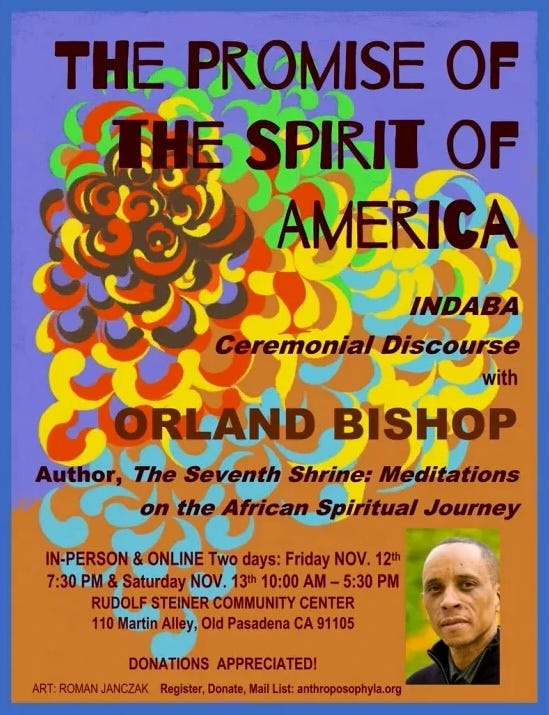
As many of us turn our attention today to the 250th anniversary of the United States of America, we’re invited to reflect on the country’s future in light of our present understanding of its past. Where have we been and where are we heading? We may call to mind certain political, social, and economic developments that represent important milestones in our understanding. Some hopeful, while others less so.
However we understand this moment, how might we also approach the meaning of America from the standpoint of our deeper potentials as human beings? Like its relationship to our capacity to listen, to meet and understand those different from ourselves, to support the flourishing of people we may never know, to love without conditions, to forgive. Quite a different kind of reckoning.
In this three-part dialogue, Orland Bishop invites us to contemplate how the promise of the spirit of America calls us to grow, to change, to become more fully human. By considering the “spirit of America,” we aren’t being asked to adopt a new belief system or consider something abstract. We can simply bring to mind the real yet subtle qualities of cognition we each encounter on a daily basis, such as our habits of thought, a flash of inspiration, an instance of prejudice, or the quiet knowing that we ought to do something differently. This ‘inner history’ of one’s relationship with cognitive qualities uniquely American is as deeply personal as it is universal, which is one reason why the words of gifted writers like Emerson, Angelou, and Dickinson continue to resonate across time. Our collective fears and the peace required to overcome them rest at this level of meaning, the boundaries of the soul. Can we then also understand America through our spiritual and moral interior, both with and beyond our understandings of its economic, political, and social struggles?
The conversation itself is where this comes alive. Some familiar names (Lincoln, King, Steiner) will appear alongside perhaps some less familiar ones (Randolph, Ligon). All three talks were given in November 2021 at the Los Angeles Branch of the Anthroposophical Society and can be viewed here, here, and here. Over the next few days I’ll be transcribing them into future Substacks for those who prefer to read them—check back on this page for links to subsequent parts. Enjoy!
Part 1
(Part 2 can be found here, and Part 3 is forthcoming)
Good evening, everyone. Really, really thank you for the invitation, Joan, Roman, and the community here at this branch of the Anthroposophical Society in America for the invitation and hospitality for tonight’s discourse. I would like to first say that I came back into this sanctuary with profound gratitude to three dear friends who are here in spirit.
But it’s their first invitation that brought me here, probably now close to twenty-five years ago or more. Their relations are in the room. Andrew, Roman, and Joan are the brothers and brother, sister-in-law of those for whom I’m speaking now: Eva Claynott Smith, Leon Anastas, and Timothy Smith.
It was through their relations with me that this space lives in my memory and lives in the present moment of our shared time tonight.
I’ve sat in this room for some of the most profound experiences, and I would like to dedicate tonight’s conversation to Leanne, Eva, and Tim. Some dear friends are also in the room because I met them because of Tim: Salvador and Pascual. I know how much Tim has been in your lives, but also ours.
And for those who are connected to Shadetree , Tim was the one who chartered our organization to be a 501(c)(3), now twenty-three years ago. And so there’s so much that’s living in the community of our time, and those who are on the other side of this threshold. I’m very grateful for their wisdom to have prepared this place that we can come and share.
Twenty plus years back, I sat in this room and participated in a mystery drama called “The Soul’s Probation.”
One of Rudolf Steiner’s mystery dramas was performed and expressed here. And I thought, “What a title!” That the soul could be on probation. We know it from cultural language here that, you know, there are a lot of juvenile probation and adult probation when people are in violation of the law. But what is the soul’s probation?
What speaks to this area of reality in which the soul could be out of touch with time or place or purpose, and what happens when the soul is seeking its place in time.
That journey would remain with me. That question of what is it that the soul is seeking would remain with me in relationship to Anthroposophy until the subsequent year, that was 1994 when I saw that.
And to do an internship at the United Nations in Geneva, and I was invited by Sophia Walsh, who was the director of the mystery drama, to come to Dornach for a weekend. And I traveled there and entered into this temple for the human soul that Rudolf Steiner had designed and created within the community of the Anthroposophical Society. Sunday morning, I arrived there.
No one was there other than myself, Sophia, and the custodian who had all the keys for all the rooms of this amazing Goetheanum. And Sophia was at that time in a wheelchair, so she wasn’t planning to escort me through those hills and stairs of the Goetheanum. So she asked the gentleman if he could support me being able to enter.
And he had work to do, so he opened the doors and told me to go in. No escort, no host other than the spirit of this space. And so the only thing I could do is look at it and ask myself the question, “What is this for?” And I sat there in meditation.
And Sofia said, “Take as much time as you need. I’ll be here.” She sat in the car.
And what was presented here as the soul’s probation entered me through meditation in the Goetheanum as a kind of remembrance. How do we remember what we have forgotten coming into existence, coming through all of the cultural challenges of life.
And what it is to be in touch with a form of cognition that could put everything back into perspective, into meaning.
And so I’m grateful that those who are in practice with anthroposophy could host such a space that we could have this discourse tonight. Because what I really want to talk about in “The Promise of the Spirit of America” is not so much a what, or even who promised what, but more why. Why is it that human beings could choose when, where, and how reality come to be?
And I’m grateful that we could choose to be here tonight to explore the why of being human.
I’d like to begin from this text I wrote some time ago with a poem from the poet Langston Hughes, an African American bringing these words to the page in the 1920s:
I’ve known rivers:
I’ve known rivers ancient as the world and older than the flow of human
blood in human veins.
My soul has grown deep like the rivers.
I bathed in the Euphrates when dawns were young.
I built my hut near the Congo and it lulled me to sleep.
I looked upon the Nile and raised the pyramids above it.
I heard the singing of the Mississippi when Abe Lincoln went down to New
Orleans, and I’ve seen its muddy bosom turn all golden in the sunset.
I’ve known rivers:
Ancient, dusky rivers.
My soul has grown deep like the rivers.
Now when I read this in high school and through college and through life, it may sound like any other poem, but this is not just another poem. This is the voice of a soul who chose a time among a group of people and said, “It’s time for the return to the service of the soul’s tasks in culture.” To claim memory as the school into which the initiation of what comes next will happen. The words are the principles of a school of knowledge, pointing to the soul as the school of knowledge. He took the school, the soul, out of probation.
You get the point? Structured through language, the capacity to give the soul a space from which it will create what then came later as the Harlem Renaissance. A restoring of all the vital pieces of intelligence, creative intelligence, through the arts, mostly through the arts, to define a pathway to contribute to the spirit of America by remembering what the soul carried as he said, “from the time when the world was young.”
We’re now discovering that water, all the waters of life that flow through all the civilizations, in fact created these civilizations, inspired the human beings on the edges of all those rivers to remember something of the soul and raise pyramids above them, raise cities above them. But also cross them, as it is often mentioned in Christianity, crossing the Jordan River and coming out on the other side a Christian. Starting here as a non-believer in the everlasting eternal power of life, and by going in and coming out, one is resurrected or restored to the primal state of knowing.
Water has served humanity in this way. We can also speak to those who are carriers of this great womb of life, who have given birth to children in the world, to know the power of being in that womb for nine months and yet acquire all kinds of futures from the water of life in the womb. This poem has struck me since I read it first.
The different civilizations and times that each of these rivers that were mentioned, but I want to come to the one that has to do with America: the Mississippi. Old Man River. Paul Robeson did a great version of that song and others. What is it that was mentioned in this poem? That when Abraham Lincoln went down to New Orleans, what happened to him that brought the African soul out of probation, slavery.
Lincoln was transformed by spiritualism that was perfected at the Congo Square in New Orleans. It was the only place where Africans were allowed to drum, were allowed to ceremonialize the soul’s resistance against enslavement. And it became a shrine, a place of immense reverence for the deep return from this soul’s probation.
But it wasn’t just the return for Africans, it was a return for the Europeans to come back to the river that made America America. Without the Mississippi, there will be no of many of the things that formed the empire that America became as a result of this exile of millions of people on one side of the river and others on the other side enjoying the benefits of slavery. Lincoln had to take his own soul out of exile and chose to do the correct thing of emancipating the soul from slavery.
He had a lot of help. The dead that was constellated as a spiritual school, a spiritual lodge in New Orleans facilitated for him an awareness. Lincoln was in fellowship with Paschal Beverly Randolph, who was head of the Masonic Lodge in the Western Hemisphere-- not only the United States, but the entire Western Hemisphere. He was considered one of the highest initiates of the era, who created the scientific ways by which we could work with the dead of this continent and created a spiritual school in Philadelphia, of which Lincoln was a member.
The White House then was not just for policy, it was for prophecy. Meaning they were engaged in studying what comes next if the soul could experience for its time the right purpose. And Randolph’s work was to prepare prophetic spaces, what we call now temples and lodges, for initiation of those who had the responsibility to promise America something that it didn’t have then: the rights and privileges of an emancipated soul.
This poem comes after the souls were released from probation, what we call the “emancipation proclamation.” In the tradition that I’m speaking, what this book meant to me, the teachers that I mentioned in the text meant to me coming out of that lineage of P.B. Randolph and others, but particularly Randolph, who had to reconstitute the Egyptian wisdom into the Americas, supported by his belonging to all the Masonic and Freemasonry lodges in Europe, including France and others, because he was an advisor to the courts in Europe about their processes, their potential transformation. The ones that were mostly willing to go along with it were France. The others, not so much. British, no.
Even in the Reconstruction time, Randolph was not politically approved as the creator of the reconstruction movement, but he was in the esoteric school of it. So 40 acres was a number representing equivalency of degrees of initiation. Like 40 days in the wilderness. Or 40 days and nights of rain of Noah and the flood. Whatever number 40, the significance was that these people were entitled to the rights and privileges of initiation, and the acreage was just a number representing the esoteric agreement hidden within the structure of that time. Now, 40 acres may not seem a lot of land, but to an emancipated soul, it was enough to create significant wealth because of the relationship to the land when they were in bondage.
So they didn’t just plant cotton and reap cotton, they planted futures. They worked within the inner processes of the life of this earth and created a door of return from exile that will last generations to come. Meaning that the souls that will choose that door to come into this world will not forget who they are.
I chose that door. Why this text is about the return and does it from where? From memory. And we are inviting the relational spaces of this cultural story to ask what do we want to remember about the promise and the possibilities of deeply engaging the esoteric path of the soul along with the exoteric path of the mind into what could be a new way of looking at the powers of places that we name America or France or Germany or wherever we might find belonging.
But the critical thing for that unity is that the souls have to choose to return to the primary agreement that we made with life itself.
That’s the first key to this path of belonging.
Human development is the path. And it’s the acceptance of a super-sensible reality. Meaning somebody can say, “But prove that you could remember that I have known rivers ancient of the world. Where’s the proof of that?” So if we trust each other with the agreement that we can know, we’ll have the effect. The evidence of the super-sensible world requires that the human being trusts the source nature in each other—and why it’s so hard for policy and laws to work, because we don’t trust who wrote them. And we don’t trust that, if I truly believe in them, they will give me liberation. Most people want their liberation and not just lawful obedience because most lawful obediences keep the soul in probation. That’s what probation is for, to keep us from remembering and exercising sovereignty over memory. And it’s difficult to live without memory.
So this first key that I would like to speak to is the intellectual basis for idealism in philosophy or we call spiritual activity—intellectual basis for idealism. So what does a promise really mean? Who defines the scope of a promise, particularly for America? Whose wisdom could guide all these millions of souls to do the right thing for America. Because it has to be ideal if the soul is going to take it up. Souls just don’t do things for conveniences. Does it because futures depend on it. Other beings who will come after depend upon what the soul does now. And if we don’t do right with it when we leave the body and go back to where the soul’s abode is, where the soul lives, we will be in probation there, because we’ll have to answer the questions. Why did you not do the truth with the life you were given? ‘Cause those laws, those spiritual laws, the esoteric laws that govern creation keeps us to our word. If we don’t do it now, we’ll go back and do it again.
Rudolf Steiner written some quite interesting plays about these pathways of development. Some good books about them, including the Philosophy of Spiritual Activity or … Freedom. The process of healing the consequences of the mistakes of our civilization. The book was written to heal the consequences of our civilization, the mistrust of the power of agreement for freedom.
So I’m grateful that I came here and sat in that presentation and asked myself the question, “Why are we choosing probation instead of freedom?”
We’re closer to the path that I want to invite us to have some conversation around. The seeker is prepared, or a seeker is invited to be prepared to perceive and cognize beyond all normal boundaries of self towards the truth that prepare the path of knowledge. We’re to know something. And the seeker, us, we’re asked to accept going beyond the boundaries, crossing the Jordan River. And it meant going beyond the intellectual, say, avoidance or what the soul requires from knowledge, which is to be a fulfilled soul for the time in which it could give its intelligence to world creation. So when I was working on this text and I talk about initiation of Africans in slavery, people say, “Well, they were in bondage. How could freedom be found in that?”
Well, this is why it’s about an esoteric understanding of the experience. Because if you’d only look at it from a physical vantage point, there is no freedom. But we are not just physical beings. And what the human thinking process could do matters to the spiritual world more so than what our physical capacities can do in the physical world. The spiritual world depends upon the human beings for thinking. Thinking- feeling. Right thought that can lead to right action, but right thoughts first. Its energies lawfully follows what we think. And those who were in this enslaved experience still utilize their thinking for realities that went into the super-sensible world, not the physical world. Physical world that got the cotton. The spiritual world got their love. Got their dreams. Got what the soul understood about the dilemma of not being in the right relationship with others in the physical world. What else could happen in that time and future times, if the soul chose to give away its fortune to another generation. This is the critical thing about this first path of development.
Accepting the super-sensible world as more real than this one and choosing to be ideally a host for something to come, prophecy. Prepare to hold something that is not yet here and will not be here until we are in right relationship with each other. We could have more of this stuff every day by manipulating each other. You can still pay people to do things that they don’t love. It happens all the time. But to create something that is ideal for its time and place, and to allow futures to be invested in it by beings who create world realities requires that we actually embody the word with integrity and trust and love for the futures that will come from that. And this means that we have to move beyond the normal boundaries of self-interest towards a truth that establishes spiritual communion with other beings.
So where are these gifts of the enslavement of these people? Where are the gifts? What happened to what the soul did in those 400 years of initiation? We got some great music from it. From negro spirituals all the way to jazz. And what was the purpose of the music? Why did the music come before the science? Why did the music come before the philosophy? To harmonize the soul. The soul knows it’s easier to convert people to music than to convert them to religion. The body loves music. And Rumi says it’s a memory. Why the body loves music, we’ve heard it before coming out of the universe. It was an esoteric school to weave these African drums into all the expressions of music. It’s been one of the greatest world relations. Not contained in libraries, but in bodies. People remember them from childhood. I love Michael Jackson. Why? He made me dance. Culture. Let me think.
All in preparation for another, another step in soul development. The intellect can say all kinds of things about the art form and what inspires it from where, and that’s not my work. My work is to say what the soul is trying to do with it, and why the esoteric understanding of the liberal arts and sciences matters to our current agreement structures and development of the intellect so that we don’t continue to neglect what the soul is trying to enter as a new covenant with our world, and in doing so, we could refine our interactions towards trust and let these other beings complete their work.
And in anthroposophy, we know Steiner always pointed out that the society was not just for us. It was for the beings who through us continue their work in this physical world.
And a society that is dedicated to soul- spiritual striving means that we have to acknowledge and accept the invisible guidance of those knowers who remain in the supersensible world, from there inspire us to do what we can do for our time.
I was in West Africa, this was in 1999, and we were hosted by an elder who was 110 years old. And he was about seven when he said, you know, a group of individuals were being taken by chains through the village where he was. And we were sat right onto the tree where he said they rested before being taken. And as much as one can say that slavery and other things ended at a certain time, nobody gives up the economy by law, like it’s illegal. Slavery is actually so alive now all over the world. It’s estimated at least close to 40 million people are in slavery right now. So it’s not about emancipation and legal structures. It’s about the ethics of allowing a soul to be human in its entire expression, including physical emotional, mental, spiritual.
This elder was providing for us a context of initiation where it was those who he witnessed leaving in chains were coming back as knowers of something that he had to prepare for their return into the, say, the etheric realm of this physical world, or what we call our climate.
Did that make sense? That they were bringing back climate as justice. I haven’t talked about this much. Of what the dead really does for our planet. I’m glad I have a lot of close friends on the other side. They trust me with their super- sensible knowing. There’s no bribing them for knowing anything. Like, I’m going to sleep. I’ll see you soon. And Tim and all, all of them who studied in this space speak back to us what their soul is now perfecting in the spiritual world. So if we could stay awake and do the work and honor our agreements with the reality that we are to serve.
And this elder told us that the subsequent year from 1999 to year 2000, you know, the big decade of what we call Age of Information and all kinds of stuff, Y2K and all of these things. You remember those days where we thought the world would crash and we’ll have nothing. So the Y2K big event, that AI wouldn’t survive the transition of time. We programmed them to function that way.
We forgot that we created the computers that we didn’t think would change over to the year 2000. But what was most critical, he wasn’t telling us about computers. He was telling us about the environment, that the rains will come. And there were floods in the entire western coast of Africa. Unprecedented levels of water entered the world. And it’s still happening. Moving. Unprecedented upsurges of warmth, soul forces magnetizing this physical earth to humanize human consciousness, to wake up our neglect and avoidance of initiation and to challenge the scientific paradigm of knowledge on all levels. And to bring the world closest to sense perception. “It’s hot in here,” you know, that kind of sense perception where we actually feel the intensity of the change.
All the esoteric schools and the work coming out of them prepared us to know that if we don’t honor certain things, the elemental world will reveal the discord between us and creation. Every time we lie about something, something falls out of creation and ends up in the elemental world in which the difficult will be felt in the place where we are.
So America was given a task because one we chose, some chose to be here and others were forced to be here, those who were here were asked to leave their places of refuge and sanctuary, indigenous people, and they left their memory. And we rewrote the constitution of this place to mean something of freedom. And yet we are still asking for it. So where’s the promise and who has to speak to it?
I’ll share one more thought and then we open for discourse. A meditation verse from Dr. Alfred Ligon:
I am black as the night from which the light of a new day descends.
I am past, present, and future.
I’m the anointed of heaven.
I am what I am.
I am the blended colors of life that lights the bridge into the new age.
I am seed, plant, and flower.
I’m the anointed of Earth.
I am that I am.
What are we without the power to say I am? What follows I am? ...an American? More than that, less than that? What are we to do with that part of consciousness that says, “I am here for some truth”? If I can promise you that I am, and you can promise me that you are, a gap will happen and our futures will fall through it. Nature doesn’t catch futures. Let me say that again. Nature does not catch futures. Human consciousness does. Nature prepares its futures as seeds. [Inaudible] when the soil is right, when the rain is right, when the sun is right, when the weather’s right, nature does its work. And the dead does more for nature than we do. And the challenge, the waking up, is we don’t want nature to get all that it needs when we die.
We want to be here for nature now so that we could remember the soul. And the critical thing about this initiation of enslaved will to nature is that it created the most profound intimacy with it in which this land knows the [inaudible] of the suffering. And Abraham Lincoln, after the screams of all the mothers and wives and children of the dead Civil War veterans, he went to Gettysburg and spoke his second inauguration and made them a promise that he will not forget them.
And so he was more than just a president of the United States of America of the living, he was President of the United States of America of the dead, whose covenant with him is true, not because it was written as a constitution, but because their death was written on his heart. He wrote a letter to all of the wives and children, mothers of those civil war dead. One of the most critical thing, he wrote handwritten letters and [inaudible] and sent them to as many of the dead so that their memory could be restored with dignity
It’s a President that we should get to know more of, and what he laid as the foundation for an esoteric school to make America keep its oath to what so many had died for and enslaved for. The redeeming has to do with this generation, our generation that has inherited both the exoteric reality of this promise and the inner right to fulfill it. And so this book is part of that story.
Seventh Shrine for me, not just limited to America, because it’s a name, but it’s also a word. Meaning the word aspect I’ll go into more tomorrow, why I say America’s not just a name, and because people can claim it as theirs. But a word is free, really, as a spiritual activity. Tomorrow we’ll do the spiritual activity of America as a working process. So thank you for listening.